Venture capital firms operate differently from traditional sales organizations. Most CRM software was built to support a predictable sales pipeline, focused on prospecting, closing deals, and managing customer accounts.
In contrast, VC firms manage long investment cycles that involve deal sourcing, due diligence, investment committee preparation, fundraising, portfolio management, and ongoing investor relations. Their work revolves around relationships, investment judgment, and coordination among multiple stakeholders, not transactional selling.
Because of this, choosing the right CRM system has meaningful operational consequences. A venture capital CRM influences how deal teams track deal flow, organize investment opportunities, manage relationships with contacts, and prepare reporting dashboards for partners and LPs.
It affects workflow automation, pipeline management, integration with tools such as Outlook, Gmail, and LinkedIn, and the ability to reduce manual data entry across spreadsheets and disconnected apps.
In many firms, it also influences how structured outbound outreach is executed. Several venture capital teams conduct proactive sourcing campaigns and need email sequencing capabilities or integration with sales engagement tools such as Outreach.
The ability to send bulk communications to thousands of founders, operators, or deal sources while maintaining CRM integrity is often evaluated alongside core deal tracking functionality.
Mobile functionality has also become a recurring requirement in buyer evaluations. Partners frequently travel, meet founders, or attend conferences, and they expect a mobile application that provides full visibility into relationship history, deal notes, and portfolio information without being restricted to desktop access.
This article evaluates six leading CRM platforms used by venture capital firms in 2026, comparing their functionality, pricing, scalability, and VC-specific features using consistent criteria to help firms make an informed, data-driven decision.
Comparison of Leading Venture Capital CRM Platforms
The table below summarizes how 6 top CRM platforms compare across the criteria most relevant to venture capital firms in 2026.
Each system approaches customer relationship management and deal flow management from a different perspective. Some emphasize relationship intelligence and warm introductions. Others prioritize deep customization, institutional reporting, or structured workflow control. The goal is to clarify which CRM platforms align best with different operating models, team sizes, and levels of internal technical resources.
In addition to feature comparisons, firms increasingly assess pricing transparency, email-automation limits, API access, data-migration support, and expected implementation timelines before making a final decision.
At a Glance: Quick Recommendations
While there is no single best CRM for every venture capital firm, certain CRM solutions stand out depending on operating priorities, team size, and internal resources.
Best for relationship-driven sourcing: 4Degrees
Firms that prioritize network visibility, warm introductions, and automated activity capture often look to 4Degrees for its strong relationship intelligence, integrated deal tracking, and purpose-built focus on private markets workflows.
Best for institutional-scale reporting: DealCloud (Intapp)
Larger venture capital and private equity firms with complex reporting requirements and formal governance structures typically benefit from DealCloud’s depth and configurability.
Best for highly customized ecosystems: Salesforce
VC firms that require extensive integrations, bespoke workflows, and deep API flexibility may prefer Salesforce, particularly if they have internal technical support.
Best for emerging or mid-sized VC firms: 4Degrees
Firms seeking a purpose-built venture capital CRM with structured deal tracking, relationship intelligence, and lower administrative burden often find 4Degrees aligned with their needs.
Best for modern flexible architecture and API access: Attio
Investment teams seeking flexible data modeling, developer-friendly API access, and customizable schema design may consider Attio, particularly if they are building AI-enabled or technology-forward workflows.
How We Evaluated These VC CRMs
Selecting a venture capital CRM requires more than comparing surface-level features. To provide a structured and objective assessment, we evaluated each platform against criteria that reflect how venture capital firms operate across sourcing, diligence, fundraising, and portfolio management. The emphasis was on practical functionality and long-term usability rather than marketing positioning.
We began with relationship intelligence capabilities, including network mapping, visibility into warm introductions, and the ability to uncover meaningful connections among founders, co-investors, and limited partners.
We assessed automated activity capture to determine how effectively each system reduces manual data entry through email and calendar synchronization. Given the growing importance of technology in private markets, we also evaluated each platform’s use of AI-powered functionality, including automated data enrichment, intelligent recommendations, workflow automation, and real-time insights to support faster, data-driven decision-making.
In addition, we reviewed the deal workflow flexibility and overall deal-tracking structure to understand how well each CRM supports sourcing, due diligence, and investment committee preparation. We examined LP and fundraising tracking, along with portfolio visibility, reporting depth, dashboard quality, integration capabilities, ease of adoption, long-term administrative burden, and pricing to assess both operational impact and scalability over time.
We also incorporated real-world buyer considerations frequently raised in prospect conversations, including the ability to separate relationship types beyond active deals, the quality of mobile app functionality, outbound email sequencing capabilities, API accessibility for AI-native funds, and the complexity of migrating large volumes of historical communications data from legacy systems.
Categories of Venture Capital CRM Platforms
Not all venture capital CRM tools are designed with the same priorities. While each system aims to improve deal-flow management and visibility, their structures, key features, and long-term functionality differ.
Grouping providers by operating philosophy helps clarify how various cloud-based CRM platforms support venture capital firms, from early-stage investors backing startups to larger funds overseeing multiple portfolio companies and strategic partnerships.
Relationship-First Platforms
Affinity and 4Degrees
Relationship-first CRM platforms emphasize network intelligence and consistent follow-up as central drivers of venture outcomes. Their key features often include relationship mapping, automated activity capture, data enrichment, and built-in templates that help deal teams standardize outreach and communication.
These CRMs are designed to reduce reliance on spreadsheets, streamline marketing automation, and surface meaningful connections among founders, co-investors, and LPs. Firms that prioritize sourcing velocity, investor relationships, and real-time visibility into their network metrics often gravitate toward this category.
Enterprise and Highly Customizable Platforms
DealCloud and Salesforce
These platforms focus on scalability, configurability, and structured reporting. They offer advanced dashboards, detailed metrics, and extensive customization through APIs and add-ons. Larger venture capital or private equity firms managing complex fund structures and portfolio companies may prefer this approach. However, these systems often require dedicated administrative resources and formal onboarding processes to optimize long-term performance.
General-Purpose CRM Platforms Adapted for VC
HubSpot
HubSpot is a widely used cloud-based CRM originally built for marketing automation and sales management. Some VC firms adopt it for deal tracking and investor relations because of its ease of use, ecosystem of add-ons, and built-in templates. While it can support basic pipeline management and reporting metrics, it is not purpose-built for VC-specific workflows. As a result, firms often need customization to align it with deal sourcing, portfolio oversight, and fundraising requirements.
Many firms that initially adopted HubSpot later report challenges separating LP relationships, founders, advisors, and other VCs into distinct categories. Some prospects have cited rising costs, particularly per-contact pricing models, and increased complexity over time as reasons for evaluating venture-specific alternatives.
Modern Flexible CRM Architecture
Attio
Attio represents a modern CRM architecture built around flexible data modeling and open API access. It allows firms to define custom object structures and relationship schemas rather than conforming to predefined sales-based models. While not venture-specific, it is often evaluated by technology-forward funds seeking maximum configurability and flexibility in integration.
Platform Deep Dives
Affinity
Best for: Small to mid-sized venture capital firms prioritizing relationship-driven sourcing.
Overview:
Affinity is a venture capital CRM centered on relationship intelligence and automated activity capture. It is widely adopted among VC firms that view network visibility and warm introductions as central to managing the full investment lifecycle, from initial outreach to ongoing portfolio engagement.
Strengths:
- Strong relationship mapping and automated contact management across Gmail and Outlook
- Flexible deal pipeline management with structured follow-up workflows
- Clear dashboards and performance metrics across the investment lifecycle
- Integration capabilities with LinkedIn and common data providers
Limitations:
- LP and portfolio tracking functionality may be less extensive than enterprise systems
- Customization is structured within predefined workflows
- Enterprise pricing can be significant for smaller teams
Some users indicate that while Affinity offers automation, its email sequencing capabilities may feel limited for firms conducting large-scale outbound campaigns. Others have noted that maintaining up-to-date data may still require manual oversight depending on workflow configuration.
Pricing: Enterprise per-seat pricing starting at $2,000 per user per year.
Ideal Firm Profile: Emerging managers and mid-sized venture capital firms that prioritize sourcing efficiency, relationship visibility, and streamlined management tools without heavy administrative overhead.
DealCloud (Intapp)
Best for: Large institutional venture capital and private equity firms requiring advanced configurability and governance controls.
Overview:
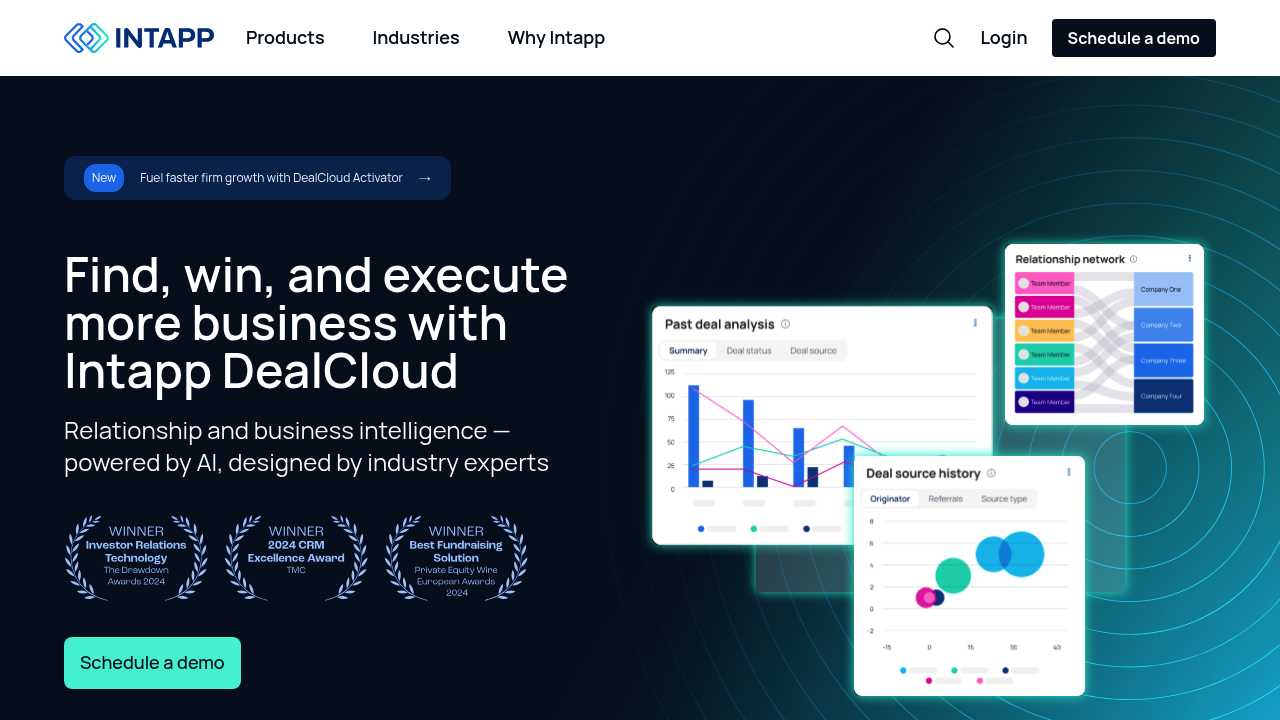
DealCloud is an enterprise-grade CRM system designed for private markets. It supports complex fund structures, portfolio companies, and detailed reporting across the full investment lifecycle, including fundraising and investor relations.
Strengths:
- Highly customizable workflows and data models
- Deep LP, fundraising, and portfolio management tools
- Robust dashboards, metrics, and granular permissions controls
- Strong integration capabilities across enterprise ecosystems
Limitations:
- Significant administrative complexity
- Longer onboarding and implementation timelines
- Higher total cost compared to lighter-weight CRM tools
- Implementation timelines for enterprise platforms such as DealCloud can extend across multiple weeks or months, particularly when migrating historical data and configuring fund-level segmentation.
Pricing: Enterprise pricing, typically quote-based.
Ideal Firm Profile: Institutional venture capital or private equity firms with dedicated CRM administrators and formal governance requirements.
Salesforce
Best for: VC firms requiring maximum customization and broad ecosystem integrations.
Overview:
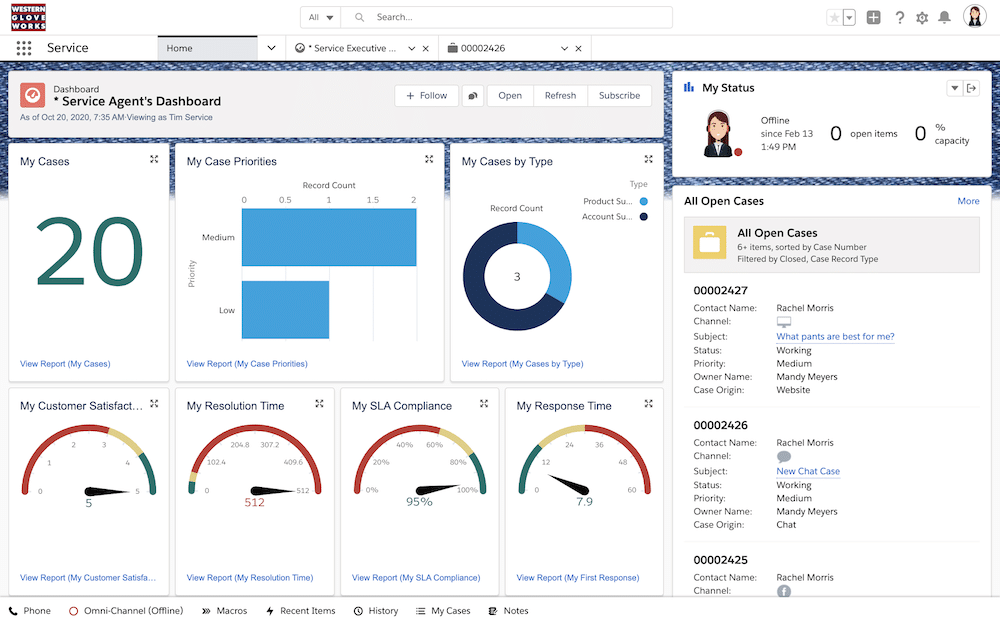
Salesforce is a general-purpose customer relationship management platform that can be configured for venture capital use. Although not VC-specific, it offers extensive functionality that allows firms to build customized workflows, contact management structures, and reporting dashboards across the investment lifecycle.
Strengths:
- Extensive customization and workflow automation
- Advanced dashboards, analytics, and performance metrics
- Large ecosystem of add-ons and API integrations
- Flexible permissions and user role controls
Limitations:
- Not purpose-built for venture capital workflows
- Requires significant configuration for deal tracking and fundraising
- Ongoing administrative management is often necessary
For firms building AI-native funds, Salesforce’s API accessibility can be a significant advantage. However, heavy customization may increase complexity and internal administrative requirements.
Pricing: Tiered per-seat pricing with additional costs for add-ons and customization.
Ideal Firm Profile: Larger venture firms with internal technical resources seeking a fully customizable CRM system and flexible management tools.
4Degrees
Best for: Venture capital and private equity firms seeking a purpose-built private markets CRM with strong relationship intelligence.
Overview:
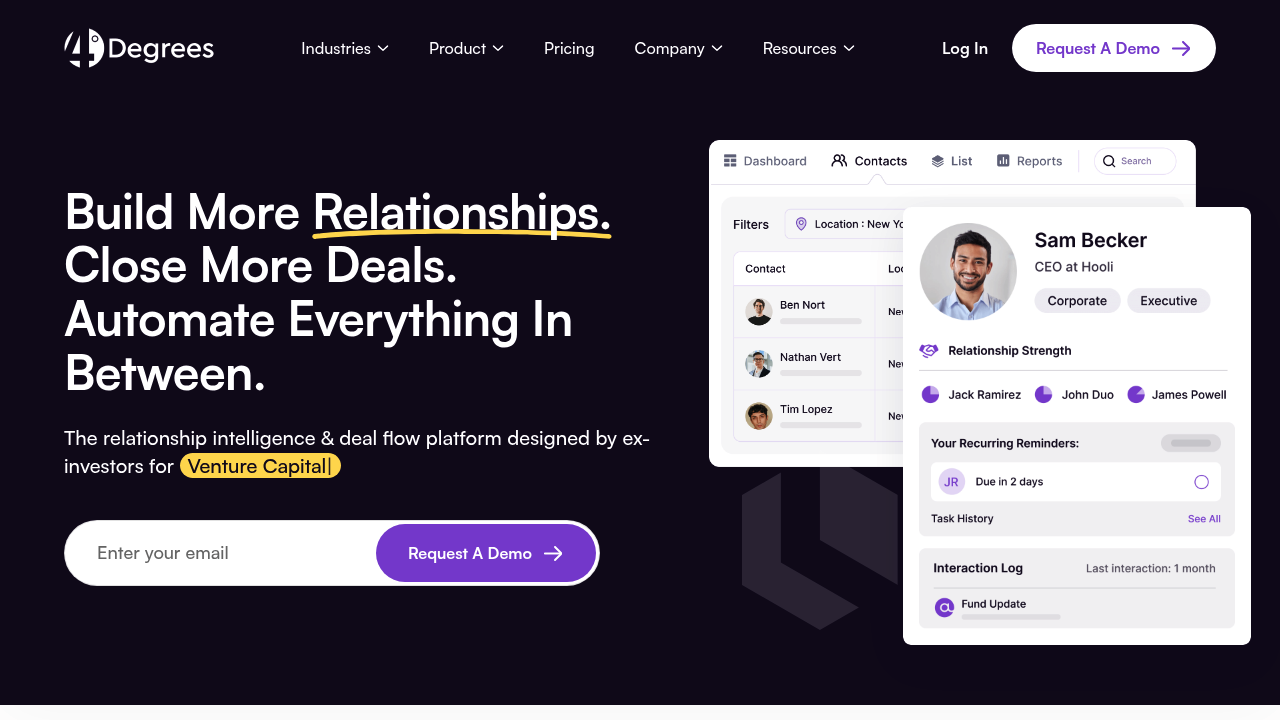
4Degrees is a venture capital CRM designed specifically for deal teams in private markets. It combines relationship intelligence, structured deal tracking, and portfolio visibility within a system built around VC-specific workflows and the full investment lifecycle.
Strengths:
- Relationship intelligence with warm introduction visibility
- Integrated deal pipeline management and contact management
- Real-time dashboards, lifecycle tracking, and reporting metrics
- Permissions controls and integration capabilities with common VC tools
- AI included in every subscription, with an AI Assistant, document extraction, and ChatGPT and Claude connectivity, with no credits or usage limits
Limitations:
- Less open-ended customization compared to Salesforce
- Enterprise-level configuration may depend on the plan tier
- Firms seeking highly bespoke workflows may require additional setup
Pricing: Per-seat pricing. Click here to learn more
Ideal Firm Profile: Small to mid-sized venture capital firms seeking purpose-built CRM software that balances automation, reporting, and relationship visibility without significant administrative burden.
HubSpot
Best for: Early-stage venture firms adapting a general CRM for lightweight pipeline and contact management.
Overview:
HubSpot is a cloud-based CRM platform originally designed for marketing and sales teams. Some venture capital firms adopt it for deal tracking, investor relations, and portfolio company communication, citing its ease of use and built-in management tools.
Strengths:
- Intuitive interface and streamlined onboarding
- Built-in marketing automation and outreach templates
- Broad integration ecosystem and API support
- Flexible permissions and scalable pricing structure
Limitations:
- Not VC-specific and may require customization for lifecycle tracking
- Limited native relationship intelligence functionality
- Portfolio and LP tracking often require configuration or add-ons
- Prospect feedback frequently highlights rising costs, sensitivity to per-contact pricing, and the need for extensive customization to properly segment LPs, founders, advisors, and other stakeholders.
Pricing: Free basic tier with paid per-seat plans and additional feature tiers.
Ideal Firm Profile: Smaller VC firms or emerging managers seeking adaptable CRM tools with basic deal tracking, outreach, and contact management functionality.
Attio
Best for: Venture firms seeking flexible architecture and strong API access for custom workflows or AI-driven initiatives.
Overview:
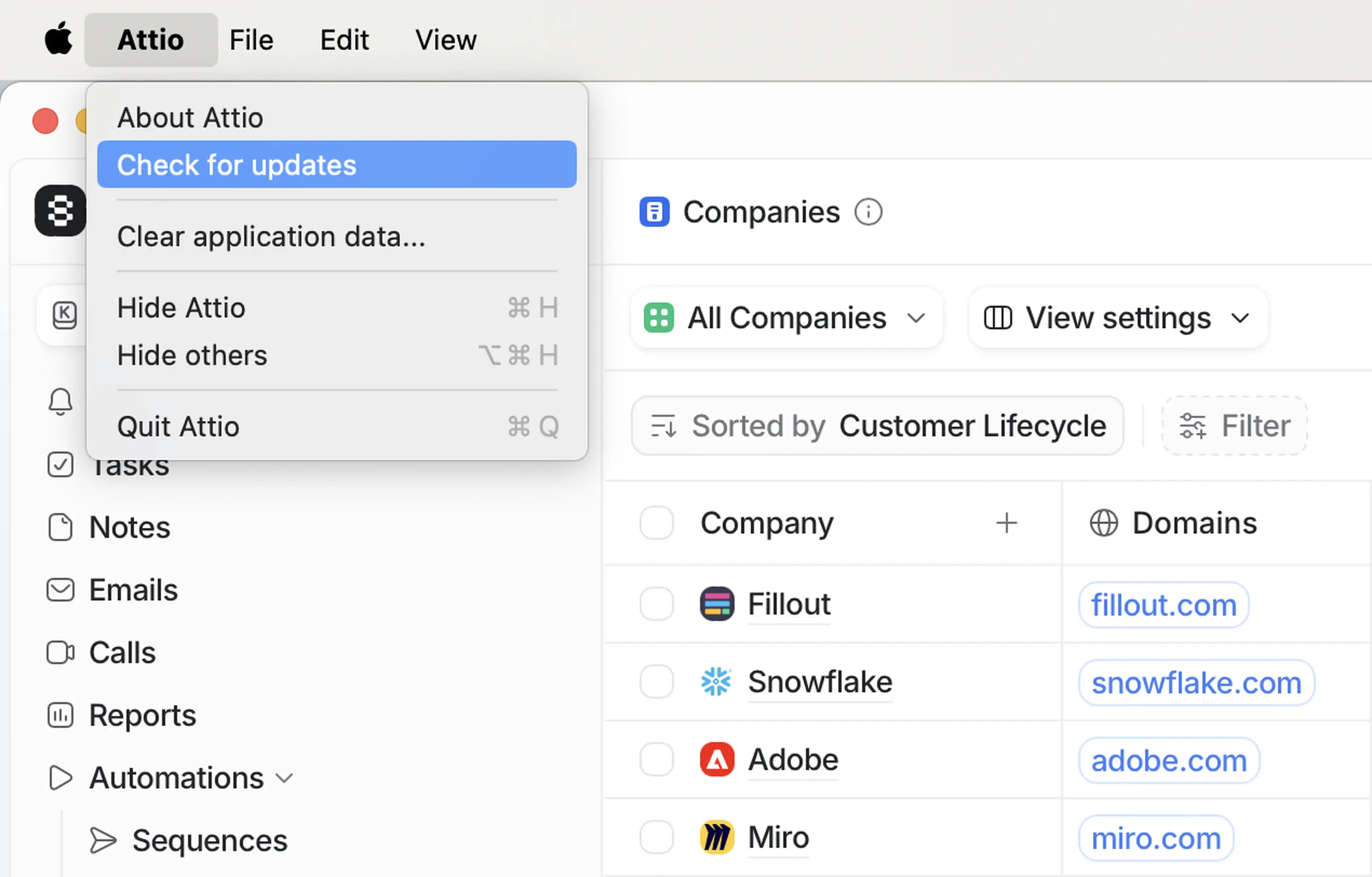
Attio is a modern, cloud-based CRM platform known for its flexible data modeling and a developer-friendly API. While not VC-specific, it allows firms to design customized schemas for contacts, deals, and relationships, which can be appealing to technology-forward funds.
Strengths:
- Highly flexible data structures and relationship modeling
- Accessible API for programmatic data access
- Modern interface and adaptable workflows
- Strong customization potential
Limitations:
- Not purpose-built for venture capital workflows
- Requires configuration to support fundraising and portfolio tracking
- Does not include native relationship intelligence comparable to specialized VC platforms
Pricing: Tiered per-seat pricing with scalable plans.
Ideal Firm Profile: Technology-forward venture firms comfortable building custom workflows and integrating CRM data into broader analytics or AI systems.
The True Cost of a Venture Capital CRM
When evaluating CRM platforms, license pricing is only one part of the equation. The true cost of a venture capital CRM includes financial, operational, and organizational factors that affect long-term performance.
License costs vary widely. Some platforms offer per-seat pricing, while others rely on enterprise contracts with minimum user thresholds and add-ons. As firms grow, scalability can significantly influence total annual spend.
Implementation time is another major consideration. Enterprise systems often require extensive onboarding, configuration, and workflow design before they reflect a firm’s investment lifecycle. Even purpose-built VC CRM tools require data setup, user training, and process alignment.
Internal administrative effort can become an ongoing expense. Highly customizable systems may require a dedicated administrator to manage permissions, dashboards, integrations, and reporting structures. Without active oversight, data quality can decline.
Data migration complexity is frequently underestimated. Moving historical deal data, contact records, portfolio information, and investor relationships from spreadsheets, Excel files, or legacy CRM software can require significant planning and validation.
Firms migrating hundreds of thousands of historical emails, meetings, and notes should assess vendor support for structured migration, timeline expectations, and post-migration data cleanup.
Finally, adoption risk represents a hidden cost. If deal teams do not consistently use the CRM for follow-up, deal tracking, and reporting, the system becomes fragmented. The most effective CRM solutions are those that investment professionals rely on daily.
How to Choose the Right CRM for Your Venture Firm
Choosing the right venture capital CRM begins with an honest assessment of how your firm operates and where friction exists today. There is no universal best CRM. The right decision depends on priorities, internal resources, and the complexity of your investment lifecycle.
If sourcing velocity is your primary focus, a relationship-first platform may be the most appropriate choice. These systems emphasize relationship intelligence, warm introductions, automated follow-up, and streamlined deal tracking. Firms that compete on access and network depth often benefit from tools that surface connections quickly and reduce manual data entry.
If reporting rigor and institutional structure dominate your operating model, an enterprise platform may be more suitable. Larger venture capital or private equity firms managing multiple funds, complex permissions, and detailed dashboards may require highly configurable workflows and formal governance controls.
If customization flexibility is critical, a Salesforce-type solution can provide broad API access and extensive configuration. However, this approach typically requires internal technical resources or outside contractors to manage ongoing optimization.
If your firm places heavy emphasis on outbound marketing or structured email campaigns, ensure the CRM supports sequencing capabilities or integrates cleanly with engagement tools without fragmenting relationship data.
Finally, if your firm lacks dedicated administrative support, it may be prudent to avoid systems that demand heavy configuration. Ease of onboarding, intuitive contact management, and sustainable long-term adoption should weigh heavily in the decision-making process.
Final Thoughts on Choosing a Venture Capital CRM
There is no universal best CRM for every venture capital firm. Each platform reflects a different philosophy around relationship management, reporting depth, and workflow control. The right choice depends on how your firm sources deals, prepares investment committee materials, manages investor relations, and supports portfolio companies over time.
Team structure, internal resources, and long-term scalability should guide the decision as much as feature lists or pricing. In 2026, automation, data enrichment, API accessibility, and clear visibility into relationships are becoming central to how venture capital firms compete. The most effective CRM system is the one that aligns with your operating model and becomes a trusted part of your firm’s daily decision-making process.