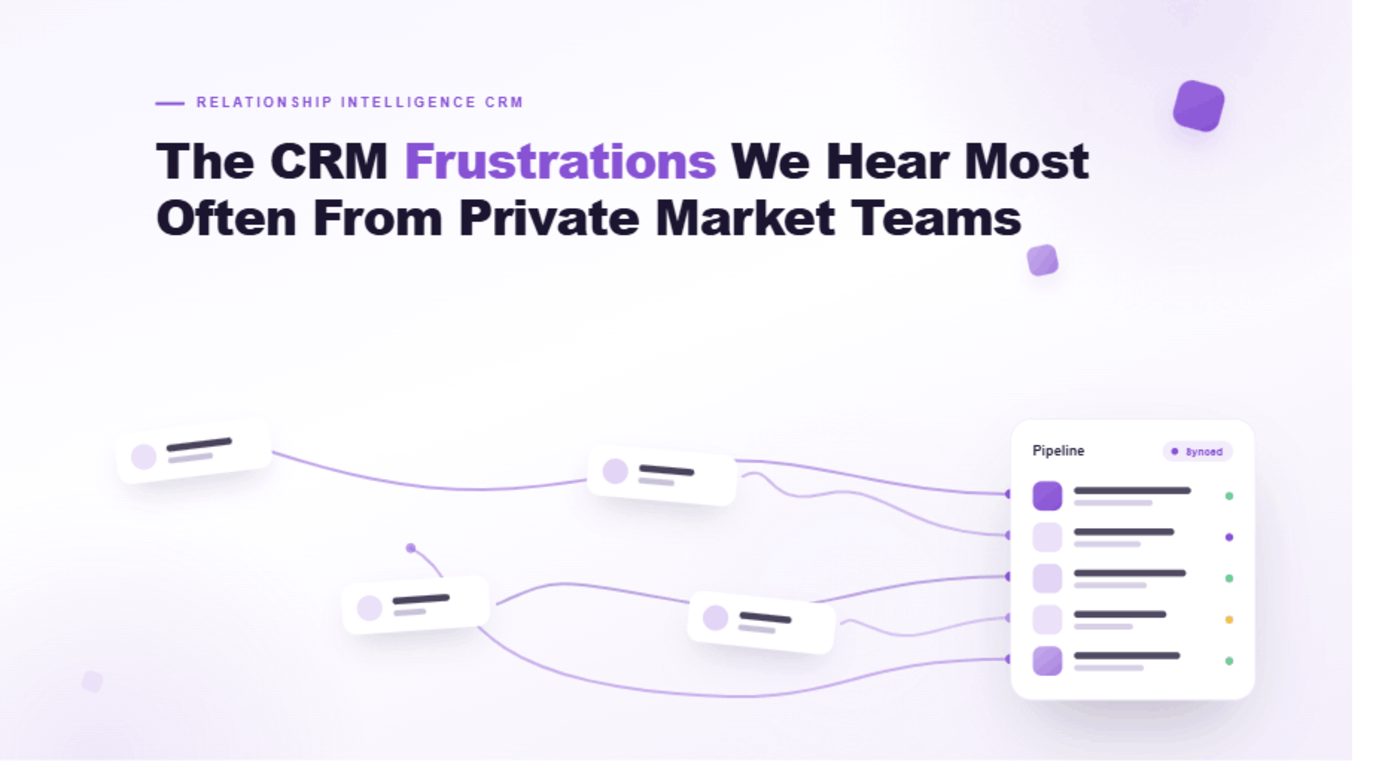
Venture capital and private equity firms don’t operate on clean, linear pipelines. Deals don’t move step by step from stage to stage. They come together through conversations, introductions, and relationships that build over time.
The best opportunities often depend on who you know, how well you know them, and whether you can reach the right stakeholders at the right moment. That makes deal flow fundamentally relationship-driven, not process-driven, and requires real-time visibility into what's actually happening across your network.
Traditional CRMs were built for sales teams, not investors. They focus on structured pipelines, manual data entry, and account tracking, which doesn’t reflect how deal teams actually work or how contact management plays out in practice.
As a result, many firms end up relying on Excel spreadsheets, inboxes, and disconnected tools, making it hard to take a data-driven approach to the metrics that actually matter. A new category has emerged to solve this: relationship intelligence CRMs.
These customer relationship management platforms are built for deal-driven teams, combining relationship tracking with visibility into deals, pipelines, and portfolio management, along with key features that better match how investors source and evaluate opportunities.
In this guide, we compare the top options and help you choose the right CRM for your firm.
The best CRM for investors depends on how your firm sources deals and manages relationships. Relationship-driven teams typically choose platforms such as 4Degrees and Affinity CRM, which are built on network intelligence and automation to capture data.
Larger, more process-heavy firms often rely on tools like DealCloud and Dynamo Software for deeper customization and reporting. General CRMs, such as Salesforce Sales Cloud and HubSpot, typically require significant modification to optimize for deal-driven workflows.
Who This Guide Is For
This guide is for venture capital and private equity firms, as well as investment banking and M&A teams that rely on relationships to source, track, and close deals. It’s designed for teams evaluating CRM platforms to improve deal sourcing, manage long-term relationships, and track deals and fundraising workflows. If your current CRM system doesn’t reflect how your team actually works, this guide will help you identify a better fit.
Top Relationship Intelligence CRMs for Investors
Understanding how these tools differ starts with a clear definition of what a relationship intelligence CRM is and how it supports deal-driven teams.
What Is a Relationship Intelligence CRM?
A relationship intelligence CRM is designed for deal-driven teams that need to capture, analyze, and act on relationships, not just track transactions. Instead of focusing only on pipeline stages and account records, it centers on the people, interactions, and connections that drive deals forward.
These platforms automate the capture of email and calendar activity, as well as the enrichment of contact and company data, so teams don’t rely on manual data entry. They surface key insights, including relationship strength, warm-introduction paths, and historical interactions across the firm. This gives teams visibility into who knows whom and how to access opportunities. As a result, relationship intelligence CRMs are better suited for non-linear deal flow and the long relationship cycles common in the private markets.
Why Do Traditional CRMs Fall Short for Deal Teams?
Non-linear deal flow breaks sales-style objects
Traditional CRMs are built around linear pipelines, where opportunities move step by step through defined stages. In deal-driven environments, that model breaks down. Deals don’t follow a predictable path, and progress is often driven by conversations, introductions, and timing rather than predefined steps. Relationship timing matters more than pipeline stages, which makes rigid CRM structures difficult to use effectively.
Manual data entry, slow sourcing, and follow-up
Most traditional CRMs rely heavily on manual data entry to stay up to date. For deal teams, this creates a constant burden that diverts time from sourcing and relationship-building. Over time, data becomes incomplete or outdated, and the system no longer reflects reality. When that happens, teams lose trust in the CRM and often stop using it altogether.
Why missing relationship signals hurts access to deals
Without built-in relationship intelligence, traditional CRMs provide little visibility into a firm’s network. Teams can’t easily see which team member has the strongest connection to a founder, operator, or intermediary. That lack of insight leads to missed warm intros and fewer chances to get into competitive investment opportunities early. In a relationship-driven market, not having access to these signals puts firms at a disadvantage.
Which Relationship Intelligence CRM is Best for Your Firm?
The right CRM depends on how your firm sources deals, manages relationships, and structures workflows. What works for a relationship-driven venture team focused on investing in early-stage startups may not fit a process-heavy private equity firm, so it’s important to evaluate tools based on how your team actually operates.
4Degrees: Best for Relationship-Driven Deal Teams
Strengths:
4Degrees is a relationship-intelligence CRM designed for deal teams that win through relationships, not rigid processes.
It combines deal flow management with relationship intelligence, giving teams a clear view of their network and the strongest paths into companies, intermediaries, and investors. The platform automates email and calendar capture and enhances records through data enrichment, ensuring contacts and companies stay accurate without manual effort, with seamless syncing across Gmail and Outlook.
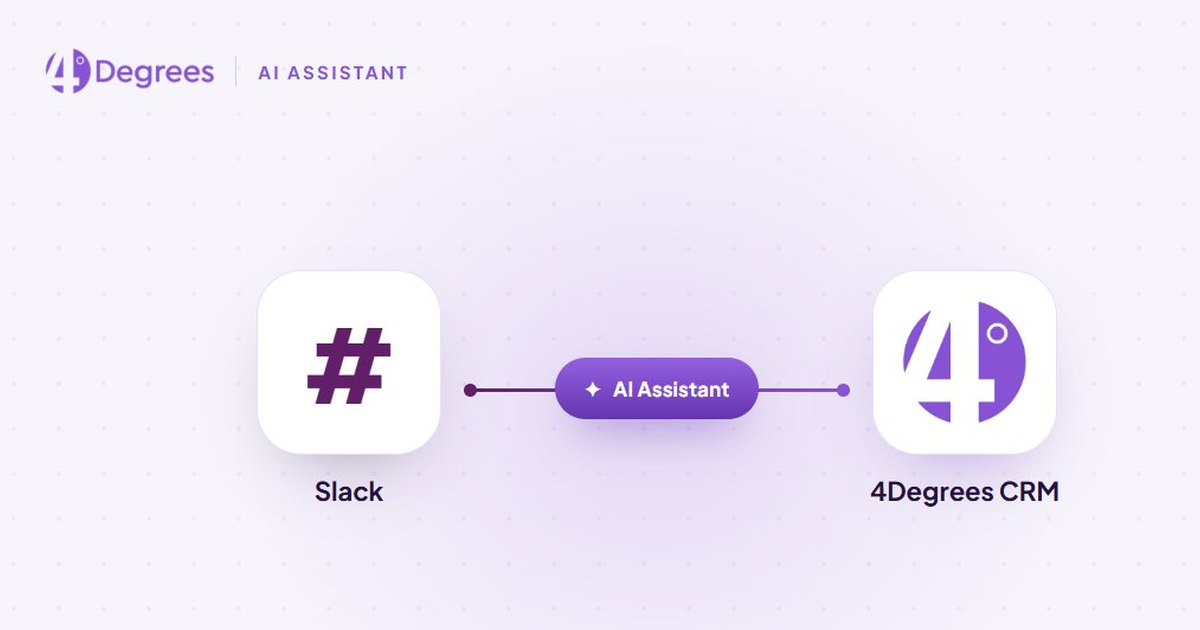
Its relationship intelligence shows who knows a contact, how strong the connection is, and where a warm introduction is most likely to succeed. Its AI Assistant answers plain-language questions using the firm’s CRM data, Document Intelligence turns deal documents into reviewable field suggestions, and the MCPconnects ChatGPT and Claude to the firm’s deal and relationship context. Together, these capabilities help teams prioritize opportunities, make better decisions, and move faster.
The user-friendly platform supports flexible, non-linear workflows that reflect how deals actually progress. It integrates with existing tools through API, providing strong integration capabilities that allow firms to connect 4Degrees to their tech stack while maintaining a single source of truth for deals and relationships. These integrations also support better team collaboration, ensuring everyone has access to the same up-to-date information across the firm.
Tradeoffs:
Firms that require highly customized, deeply configured systems may find 4Degrees less flexible than legacy platforms built for extensive customization.
Ideal for:
Venture capital firms, private equity firms, investment banks, and consulting teams that rely on relationships for sourcing and execution, who want a CRM that reduces manual work, surfaces the right connections, and helps them move faster on opportunities.
Affinity CRM: Best for Lightweight, Network-Centric Sourcing
Strengths:
Affinity is a CRM solution designed for teams that want a simple, easy-to-adopt system focused on relationship tracking and deal pipeline management.
It automatically captures email and calendar activity and maps connections across your network, giving visibility into who knows whom and helping teams stay on top of their investor relationships.
The platform includes basic automation tools that reduce manual work and keep contact data up to date without requiring constant input from the team. It is relatively quick to implement, making it appealing to smaller teams or firms that want to get up and running without a long onboarding process, while still maintaining visibility into their network and deal activity.
Tradeoffs: Affinity’s simplicity comes with limitations. Reporting dashboards and customization are more constrained than on more robust platforms, making it harder to support complex workflows or generate detailed insights.
As firms grow or need more structured processes, they may find the platform lacks the depth required to manage more sophisticated deals or fundraising operations.
Ideal for: Teams that prioritize ease of use and quick setup, and primarily need a lightweight system for tracking relationships and basic deal activity.
DealCloud: Best for Large, Complex Firms
Strengths:
DealCloud is built for firms that need a highly configurable system to support complex investment workflows. It offers deep customization across data models, pipelines, and reporting, allowing teams to tailor the platform to very specific processes within a centralized workspace.
Its reporting capabilities are particularly strong, making it a fit for firms that require detailed tracking, structured pipelines, and firm-wide visibility across deals, portfolio companies, and investor activity. The platform is also designed for scalability, supporting larger organizations as their processes and data needs grow over time.
Tradeoffs:
That customizable flexibility comes with tradeoffs. Implementations can take significant time and resources, often requiring dedicated support and ongoing configuration.
The platform can also be more complex to use day-to-day, especially for teams that don’t need that level of structure. Pricing and overall cost are typically higher as well, both in terms of licensing and internal resources required to manage the system.
Ideal for: Large private equity, VC firms, and institutions with defined processes, dedicated operations teams, and a need for deep customization and reporting across the organization.
Dynamo Software: Best for Fundraising and LP Workflows
Strengths:
Dynamo Software is designed for firms that place a strong emphasis on investor relations and fundraising. It provides robust tools for LP and investor tracking, helping teams manage communications, commitments, and ongoing relationships with limited partners.
The platform supports fundraising workflows, making it easier to organize outreach, track progress, and maintain visibility into capital-raising efforts.
Tradeoffs:
Dynamo is less focused on deal sourcing and pipeline management, which can make it a weaker fit for teams that prioritize finding and evaluating new opportunities. The user experience can also feel less intuitive compared to more modern platforms, which may slow adoption for some teams.
Ideal for:
Firms that are heavily focused on capital raising and investor relations need a system to manage LP relationships and fundraising processes alongside their investment activities.
Navatar: Best for Salesforce-Based Teams
Strengths: Navatar is built on top of the Salesforce ecosystem, making it a natural fit for firms already using Salesforce or that want to stay within that environment. It extends Salesforce with templates and workflows tailored to investment firms, enabling teams to leverage existing infrastructure, integrations, and platform familiarity.
Tradeoffs: Because it relies on Salesforce, Navatar often requires significant configuration and ongoing management to fit a firm’s workflows. This can increase both implementation time and operational overhead. It can also feel less flexible and slower to adapt than newer platforms designed from the ground up for deal-driven teams.
Ideal for: Firms that are already committed to Salesforce and want to build on that foundation, rather than adopt a standalone CRM built specifically for relationship-driven deal workflows.
Salesforce Sales Cloud: Best General CRM (Not Deal-Focused)
Strengths:
Salesforce Sales Cloud is one of the most widely used CRM software and offers high flexibility. It can be configured to support a wide range of use cases, and its large ecosystem of integrations and third-party tools allows firms to extend functionality as needed.
For organizations with internal technical resources or with a substantial budget for external consultants, it provides a foundation that can be adapted to many different workflows.
Tradeoffs: Salesforce was built for traditional sales processes, not for deal sourcing or relationship-driven workflows. As a result, investment teams often need significant customization to make it usable, which can increase both cost and complexity. Even with customization, it may not fully capture the nuances of relationship intelligence, such as network visibility or warm introduction paths.
Ideal for: General sales use cases or organizations that already rely heavily on Salesforce and have the resources to customize it, but are less suitable for specialized deal teams that need purpose-built tools for sourcing and managing opportunities.
How Should Venture Capital and Private Equity Teams Choose a CRM?
Venture capital firms should prioritize speed, ease of use, and strong relationship tracking when evaluating a venture capital CRM. Teams need to move quickly on opportunities, maintain visibility into their network, and avoid systems that require heavy manual input or complex setup. CRMs that automate data capture and surface relationship insights tend to perform best in this environment.
While both 4Degrees and Affinity are commonly used by VC firms, they serve slightly different types of teams.
Affinity is often a better fit for smaller or earlier-stage firms seeking a lightweight system they can adopt quickly without extensive configuration. It works well when the primary need is tracking relationships and basic deal activity, and when the team is willing to trade depth for simplicity.
4Degrees is typically a better fit for firms that want more structure and visibility as they scale. It goes beyond simple network tracking by combining relationship intelligence with deeper support for deal workflows, reporting, and AI-driven insights. This becomes especially valuable for firms managing higher deal volume, more complex pipelines, or multiple team members sourcing and evaluating opportunities simultaneously.
In practice, the choice often comes down to how your team operates today and how much complexity you expect in the future.
Likely fits:
4Degrees
Affinity CRM
Best Fit for Private Equity Firms
Private equity firms should prioritize strong reporting, clear deal pipeline structure, and visibility across the investment lifecycle.
Teams often need to track multiple deals in parallel, generate consistent reporting, and maintain oversight across sourcing, diligence, and portfolio activity. CRMs that support structured workflows while still providing relationship context tend to be the best fit.
Likely fits:
DealCloud
Dynamo Software
4Degrees (relationship layer)
Best Fit for Firms That Need Deep Customization
Firms that require highly tailored workflows should emphasize configurability and the ability to adapt the system to specific internal processes. These organizations often have dedicated resources to manage and maintain a customized CRM environment and are willing to trade simplicity for flexibility.
Likely fits:
DealCloud
Salesforce Sales Cloud (and broader Salesforce ecosystem)
Common Mistakes Investors Make When Choosing a CRM
Choosing a sales CRM instead of a deal-focused CRM
Many firms default to general-purpose CRMs like Salesforce because they are familiar. The issue is that these systems are built for linear sales pipelines, not relationship-driven deal flow. The result is a tool that requires heavy customization and still doesn’t reflect how deals actually happen.
Underestimating the burden of manual data entry
On paper, manual data entry seems manageable. In practice, it rarely works. If a CRM depends on users to log emails, update contacts, and maintain deal records, adoption drops quickly. Over time, the data becomes incomplete, and the system stops being trusted.
Ignoring relationship intelligence when evaluating tools
Some teams focus heavily on pipeline tracking and reporting, but overlook how deals are actually sourced. Without visibility into relationship strength and network connections, firms miss opportunities for warm introductions and early access to deals. This is often the difference between being in a process and winning it.
Over-prioritizing customization over usability
Highly customizable platforms can look attractive during evaluation. But in many cases, they introduce complexity that slows teams down. If a system requires ongoing configuration or technical support to maintain, it often becomes difficult for deal teams to use consistently.
Not aligning the CRM with how the team actually works
The most common failure is choosing a CRM based on features instead of workflow. A relationship-driven venture team needs a very different system than a process-heavy private equity firm. If the CRM doesn’t match how deals are sourced, tracked, and executed, it won’t be used effectively.
What Features Matter Most in a Relationship Intelligence CRM?
The best relationship intelligence CRMs don’t just offer features; they execute them in ways that match how deal teams actually work.
Relationship intelligence and network mapping
Strong platforms go beyond showing connections. They quantify relationship strength, surface the best path into a company, and make that insight easy to act on. Weaker tools require manual digging and rarely influence real decisions.
Automated data capture and enrichment
Top systems automatically capture email and calendar activity, enrich contact and company data, and keep records up to date without user input. Less effective tools still rely on manual entry, leading to incomplete and outdated data.
Flexible deal pipeline management
Deal flow is rarely linear. The best CRMs adapt to how deals actually progress, while rigid systems force teams into predefined stages and often push them back to spreadsheets.
Reporting and insights
Strong reporting goes beyond dashboards and provides actionable insights into pipeline health, relationship coverage, and sourcing performance. Weaker systems generate reports but don’t improve decision-making.
Integrations and AI capabilities
Modern CRMs need to connect seamlessly with other tools and use AI in a practical way. The best platforms surface insights, answer questions, and extract data from documents, while weaker ones treat AI as a superficial add-on.
It is also worth checking whether the CRM can share context with the AI tools your team already uses: Model Context Protocol (MCP) support, for example, lets assistants such as ChatGPT and Claude answer with the firm's own deal and relationship data instead of generic knowledge.
See How 4Degrees Fits Your Deal Flow
No single CRM fits every firm, especially in environments where relationships drive outcomes. Deal-driven teams need relationship intelligence to surface the right connections, move faster on opportunities, and stay ahead in competitive processes. The right system doesn’t just track activity; it improves sourcing, strengthens relationships, and leads to better outcomes.
See how 4Degrees helps your team turn relationships into deals, request a demo here.