Who Are DealCloud's Competitors?
DealCloud competitors include 4Degrees, Affinity, Salesforce, Dynamo Software, Navatar, Altvia, and Meridian AI. DealCloud (formerly Intapp DealCloud) competes with these platforms across private equity, venture capital, investment banking, and commercial real estate.
The primary differentiators are implementation speed, relationship intelligence, automation, pipeline management, flexibility in customization, and total cost of ownership. The right alternative depends on firm size, internal resources, and the degree to which the platform needs to integrate with back-office workflows.
How we evaluated these platforms. This guide compares the eight most-considered DealCloud alternatives based on verified user reviews from G2, Capterra, and Software Advice; published procurement data from Vendr, vendor product capabilities as of May 2026; and conversations with 4Degrees' customer base across hundreds of private market firms.
We weighted use cases specific to private capital, not generic sales teams’ workflows.
Which DealCloud Competitor Is Right for You?
Before reading vendor by vendor, this prescriptive view helps narrow the field:
- Emerging manager or sub-$1B AUM PE firm focused on relationship-driven sourcing → 4Degrees or Meridian AI
- VC firm where Gmail is core and adoption matters more than customization → Affinity or 4Degrees
- PE or IB firm already standardized on Salesforce that doesn't want to migrate → Navatar or Altvia
- Multi-asset firm needing integrated fund accounting, portfolio monitoring, and CRM in one platform → Dynamo Software
- Large enterprise firm with complex LP relationships, fund admin needs, and structured compliance workflows → DealCloud
- Firm with extensive existing Salesforce investment and dedicated admin resources → Salesforce
The vendor profiles below explain why each placement holds up.
Why Firms Evaluate DealCloud Competitors
Intapp DealCloud has been a fixture in capital markets for over a decade. It centralizes deal workflows, integrates with Microsoft Outlook and Excel, and supports the governance and reporting requirements of large financial services firms.
For organizations with structured investment committees, large LP bases, and mature back-office operations, that depth is genuinely valuable.
The friction shows up elsewhere.
Implementation cost and timeline. According to procurement data published by Prospeo, DealCloud contracts typically range from $85,000 to $1.43 million per year, depending on firm size and the number of module bundles.
Implementations routinely take 6 months to 2 years. G2 and Capterra reviewers describe initial setup as challenging, with meaningful workflow changes after go-live often requiring additional professional services engagements.
Reliance on manual data entry. Despite AI additions through Intapp Assist, 3rd-party reviewers note that DealCloud does not natively automate multi-degree relationship intelligence. Deal teams still log key interactions to keep the system up to date.
Integration constraints. Reviewers have flagged limited native API availability, with one reviewer reporting they were encouraged to build integrations independently or pay DealCloud's professional services team. As tool interoperability becomes a procurement criterion, this closed architecture is a structural concern.
Adoption friction. G2 reviewers describe the interface as clunky with a steep learning curve. For smaller deal teams without a dedicated CRM administrator, the platform often becomes a system of record rather than a tool that actively drives sourcing and outreach.
Many teams end up running parallel spreadsheets to compensate for the gaps, which defeats the purpose of consolidating into a CRM in the first place.
The 7 DealCloud Competitors and Alternatives
Below is a closer look at some of the most widely used DealCloud alternatives and how they compare for deal-driven organizations.
4Degrees

4Degrees is a relationship intelligence CRM platform specifically designed for teams in deal-driven industries. Founded by former private-market investors, 4Degrees empowers firms to leverage their networks more effectively to secure warm introductions and close deals faster.
Serving as a central hub for both deal and relationship management, it ensures that teams are always informed about the progress of each deal throughout the entire investment lifecycle.
Key Features
Automated Data Entry and Seamless Email Integration
4Degrees syncs with Microsoft Outlook and Gmail (Google Workspace), automatically logging all interactions without manual data entry. This saves hundreds of hours annually and enhances the accuracy and quality of your CRM data.
AI-Powered Relationship Intelligence
- Network Analysis and Warm Introductions: 4Degrees analyzes the strength of your team's relationship networks to surface warm introductions and identify the best paths to companies, experts, or investors within seconds. This capability significantly improves the efficiency of deal sourcing, fundraising, and due diligence.
- Real-Time Alerts: 4Degrees keeps you informed by notifying you when contacts in your network make investments, start new jobs, or experience other significant changes. These real-time insights help you stay connected with your network, nurture relationships, and uncover new investment opportunities.
Customizable Pipeline Management
- Flexible Deal Pipeline Views: allow you to view your deal pipeline across the investment lifecycle, ensuring real-time awareness of each deal's status from sourcing to closing.
- Tailored Workflows and Fields: This feature lets you customize fields and workflows to align with your firm's unique processes and needs, enhancing efficiency and long-term scalability.
Robust Reporting and Analytics
- Real-Time Dashboards: Provides a solid reporting platform with customizable dashboards that offer real-time insights and in-depth data exploration.
- Key Metrics Monitoring: Enables teams to monitor crucial metrics such as relationship dynamics, fundraising status, and deal progression, providing the data to make informed investment decisions and manage deal flow effectively.
AI Across The Deal Workflow
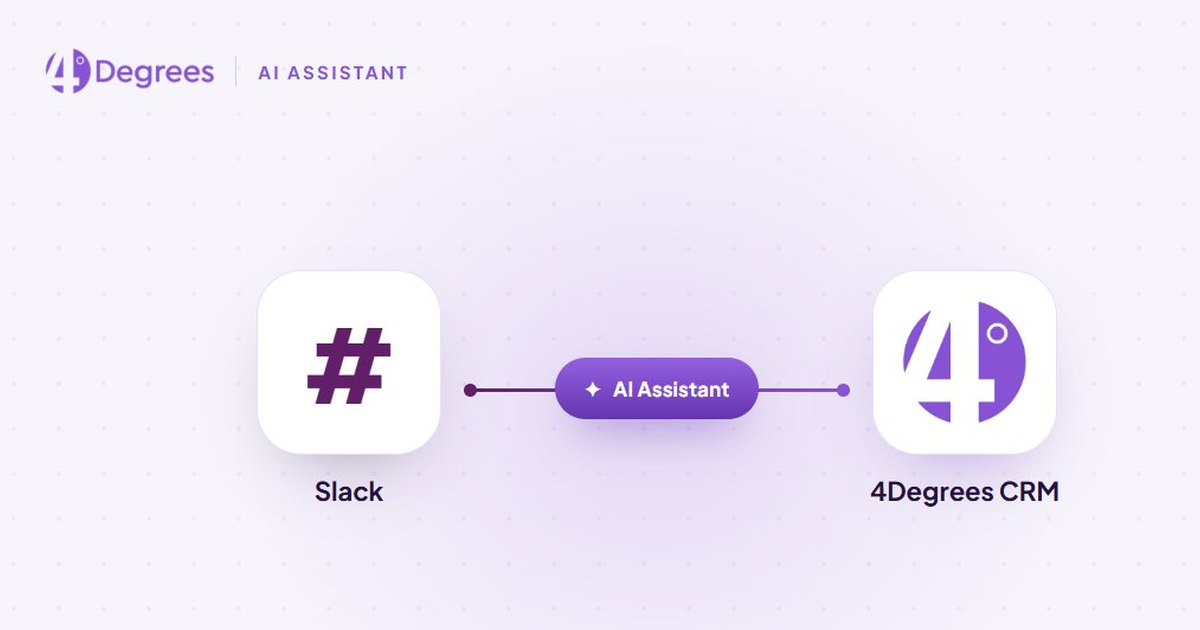
- AI Assistant: Ask plain-language questions about deals, contacts, companies, and pipeline activity and get answers grounded in your firm's own CRM data, in the product or in Slack.
- Document Intelligence: Upload CIMs, banker decks, or PDFs to a deal and review suggested field updates with confidence indicators. Nothing is written to the record without approval.
- MCP Connectivity: Connect ChatGPT and Claude to your firm's deal and relationship context for meeting preparation, research, and CRM updates with the right permissions.
- Every AI capability is included for every customer, with no credits, usage fees, or usage limits.
Considerations. The integration ecosystem is smaller than that of Salesforce-based platforms, which matters to firms requiring deep AppExchange-style third-party connections.
4Degrees is also a more focused platform than DealCloud or Dynamo; firms requiring integrated fund accounting, ILPA-standard portfolio reporting, or full back-office operations may need to pair it with a separate fund administration system.
Best for: Deal-driven teams that prioritize relationship intelligence, fast deployment, and lower total cost of ownership. Pricing can be found here.
4 Degrees Benefits Over DealCloud
Eliminate Manual Data Entry: By automatically logging interactions, 4Degrees saves your team significant time and ensures data accuracy, which is crucial for maintaining dependable relationships and gaining deal insights.
Enhanced Networking Effectiveness: Utilizes relationship intelligence to leverage network connections for warm introductions to deal sources, experts, investors, etc., enhancing deal flow and pipeline management.
Stay Informed: Real-time alerts and dashboards keep you updated on deal progress and network changes, allowing for proactive decision-making and efficient pipeline management.
Industry Expertise: The product and customer support teams at 4Degrees possess deep industry knowledge and an understanding of deal teams' unique needs and use cases.
Responsive Service: The 4Degrees team provides timely support (included in the monthly subscription), ensuring you constantly get the most value from your CRM and assisting you with all your queries.
Quick Deployment: offers a smoother and faster onboarding experience with a less resource-intensive setup than DealCloud and Affinity.
Transparent Pricing: With a lower total cost of ownership and no extensive additional costs for customization and advanced features, 4Degrees is a powerful platform for firms of all sizes.
AI Included for Every Customer: DealCloud offers Intapp Assist as an optional capability rather than part of every subscription. 4Degrees includes its full AI lineup in every subscription, the AI Assistant, Document Intelligence, and MCP connectivity for ChatGPT and Claude, with no credits or usage-based fees.
For a head-to-head, see 4Degrees vs DealCloud.
Affinity

Affinity is a deal and contact management platform designed to help investment professionals manage relationships and deal flow. By leveraging automation and relationship intelligence technology, Affinity provides a centralized platform for managing your team's deal pipeline and professional networks.
Key Features
Automated Data Capture
- Email and Calendar Syncing: Affinity automatically syncs with your emails and calendars to keep contact records and communication histories up-to-date, reducing data entry and ensuring all interactions are logged.
Relationship Scoring
- Communication Analysis: The platform analyzes communication patterns to assess relationship strength. By assessing factors such as interaction frequency, Affinity assigns scores that help users prioritize outreach efforts.
Considerations
Limited Advanced Features
- Lack of Real-Time Updates: Affinity may not provide real-time news and updates about contacts, such as job changes or new investments, limiting a user's ability to stay informed about significant developments in their network.
Pricing Model
- Advanced Features Require Upgrades: Access to certain advanced features and integrations require higher-tier subscriptions. Firms may need to consider the additional costs to unlock the platform's full potential.
Customer Support
- Responsiveness for Smaller Firms: Some user reviews have reported decreased responsiveness from customer support for smaller firms, which impacts the level of assistance received by smaller teams. Priority support is available for an extra cost.
Affinity offers a solid foundation for relationship management with its automated data capture and relationship scoring capabilities. However, firms should weigh the considerations regarding advanced features, pricing, and customer support when evaluating if Affinity aligns with their specific needs.
Assessing how these factors impact your team's workflow and goals can help determine if Affinity is the right CRM solution for your organization.
Salesforce

Salesforce is the world's leading customer management software, known for its comprehensive suite of cloud-based solutions. It offers a robust ecosystem of applications designed to help businesses manage customer relationships, sales processes, and marketing efforts.
Key Features
Highly Customizable Platform
- Adaptable Solutions: Salesforce provides a flexible platform tailored to various sales workflows. Users can customize fields, objects, processes, modules, and access permissions to align the CRM with their operational needs.
Robust App Ecosystem
- AppExchange Marketplace: Salesforce's AppExchange offers a vast ecosystem of third-party applications and integrations, enabling firms to extend the functionality of their CRM systems.
- Marketing Automation: Features such as email marketing, campaign management, and customer segmentation help marketing teams execute targeted campaigns and measure their effectiveness.
Considerations
Not Tailored for Private Market Firms
- Sales-Focused Design: Salesforce is a sales-focused CRM ideal for sales teams using a traditional sales pipeline. As a sales CRM at its core, it emphasizes lead management, pipelines, and marketing automation, similar to tools like Pipedrive, which may not align with the needs of firms in the private markets.
- Workflow Misalignment: Private market firms deal with complex deal structures, long-term relationship building, and intricate investment lifecycles that differ from traditional sales processes. Salesforce may only adequately support these specialized needs with extensive customization.
Customer Support Limitations
- Lack of Industry-Specific Expertise: Salesforce's customer support team may not fully understand the use cases and challenges specific to private-market firms. This results in less effective assistance when configuring the CRM to meet industry-specific requirements.
Complex Implementation and Customization
- Resource Requirements: Adapting Salesforce to fit the private markets' workflows often requires significant time, resources, and technical expertise. Firms might need to invest in custom development or third-party consultants to modify the platform appropriately.
- Cost Implications: Extensive customization can increase costs, making Salesforce a less cost-effective solution for the private market than CRMs specifically designed for their industry.
While Salesforce is a powerful CRM, there may be better options for private market firms.
Salesforce's sales-focused design caters primarily to businesses selling goods or services. This misalignment with the unique workflows of private-market industries, such as complex deal management and relationship-driven networking, can leave firms struggling to adapt to Salesforce.
For firms in the private markets seeking a CRM that understands their specialized needs provides greater benefits.
Dynamo Software
Dynamo is a cloud-based alternative investment management platform centralizing CRM, deal pipeline, investor relations, portfolio monitoring, fund accounting, and research management in one system. It serves private equity, venture capital, private credit, real estate, infrastructure, and fund of funds.
Strengths. Dynamo's DynamoAI module provides AI-driven auto-tagging, document summarization, and conversational queries across firm data. Reviewers consistently highlight the platform's ability to consolidate CRM, fund metrics such as IRR and TVPI, cash flow tracking, and LP reporting into a single source of truth, with real-time dashboards.
Considerations. According to independent buyer guides, Dynamo functions more as a comprehensive alternative investment management platform than a focused CRM. Reviewers occasionally note that CRM functions can feel secondary to broader portfolio and back-office capabilities, and implementations involve phased rollouts that take months.
Best for: Firms that want CRM and back-office in a single ecosystem and have the internal resources to manage a multi-module deployment.
Navatar
Navatar is built natively on Salesforce and has served private capital markets for nearly two decades. In 2026, the company introduced an AI Deal Engine and AI-powered operating models for alternative asset managers, M&A advisors, and corporate finance advisory firms.
Strengths. Salesforce-native architecture provides AppExchange integration, enterprise-grade security, and Agentforce compatibility. Navatar's AI captures relationship and workflow intelligence from daily activity and surfaces next-best actions across sourcing, diligence, and investor engagement. The platform supports PE, VC, IB, private credit, real estate, secondaries, and funds of funds.
Considerations. As a Salesforce-native overlay, Navatar inherits Salesforce's underlying complexity. Navatar offers traditional CRM functionality on Salesforce but has been more conservative in its pace of innovation than AI-native platforms like 4Degrees. The platform requires a separate Salesforce license.
Best for: PE, IB, and M&A firms already standardized on Salesforce that want a private markets layer with embedded AI.
Altvia
Founded in 2006, Altvia is a Salesforce-native CRM purpose-built for the private capital fund lifecycle. The platform supports more than 40,000 LP investor relationships across hundreds of firms and received a majority investment from Marlin Equity Partners in 2022. The AIMe AI assistant captures activity and surfaces insights.
Strengths. Built specifically for private capital workflows, with strong fund and LP management modules. According to reviews, the Altvia team is consistently praised for industry knowledge and responsive support. The Correspond email tool is frequently cited as a marketing improvement over generic CRM mass email features.
Considerations. Reviewers note that the Salesforce foundation introduces a learning curve, particularly for advanced reporting and validation rules. According to reviews, more sophisticated reporting is ultimately constrained by Salesforce's underlying functionality. Pricing is reported at approximately $1,700 to $1,800 per user per year, with the Salesforce license required separately.
Best for: PE firms already on Salesforce that want layered fund lifecycle workflows, LP onboarding automation, and an AI assistant without migrating.
Meridian AI
Meridian is an AI-native CRM founded in 2023. The platform serves private equity deal teams and has been adopted by firms managing over $200 billion in assets.
Strengths. Vertically integrated AI across every feature. Scout, Meridian's AI agent, handles deal sourcing, data enrichment, and pipeline summarization. The platform bundles 26 million company records and a verified contact database into the CRM, reducing or replacing third-party subscriptions to PitchBook, Grata, or SourceScrub. Meridian supports MCP, native API access, and webhook automation. Outlook and Google Workspace integration is one-click.
Considerations. Meridian is the newest platform on this list and has a smaller customer base than legacy alternatives. Pricing is quote-based with an unlimited-user model. As with any AI-first platform, firms should validate the accuracy of outputs against their own data during evaluation.
Best for: PE deal teams prioritizing AI-native architecture, bundled data enrichment, and open integration with downstream AI tools.
Intapp DealCloud
DealCloud, owned by Intapp since 2021, serves investment banks, private capital firms, accounting and consulting organizations, legal advisors, and real assets companies.
Core capabilities. DealCloud centralizes deal management, relationship intelligence, fundraising and investor relations, due diligence coordination, and audit-ready reporting. The platform's pre-built data models cover private capital, investment banking, legal, and advisory workflows. Intapp Assist adds AI-generated summaries, smart tagging, and contextual insights inside the platform.
Module breakdown. DealCloud is typically purchased in modules: deal and relationship management, fundraising and IR, portfolio monitoring, and risk and compliance. Most large firms deploy multiple modules, which is why contract sizes scale meaningfully with firm complexity.
Where it excels. DealCloud genuinely shines in environments where investment committees, LP reporting, and workflow discipline are central. The platform handles complexity at the largest firms better than most alternatives. Highly configurable workflows, granular permissions, and structured governance are differentiators for firms that need them.
Best for: Large enterprise firms requiring deep LP relationship management, fund administration integration, complex compliance workflows, and the willingness to invest in a multi-month implementation supported by professional services.
How to Choose the Right DealCloud Competitor
Beyond the prescriptive matrix above, five questions sharpen the decision.
1. How fast does the firm need to deploy? Modern alternatives like 4Degrees and Meridian deploy in days to weeks. Salesforce-based platforms and Dynamo typically run multi-month implementations. If the deal team needs a working pipeline within a quarter, this immediately narrows the field.
2. How much manual data entry is the team willing to accept? Automation is the single largest predictor of CRM adoption. Platforms that capture emails, meetings, and contact updates passively keep their data current. Platforms that depend on associates manually logging activity degrade within months.
3. How important is relationship intelligence? Firms that source through warm introductions and banker coverage should weigh this heavily. Affinity, 4Degrees, and Meridian are differentiated here. DealCloud and Dynamo are stronger on structured pipeline and back-office than on multi-degree relationship mapping.
4. What's the right level of customization? Configurable platforms like DealCloud, Salesforce, and Navatar offer maximum flexibility but require internal admin resources or paid professional services to adapt over time. Purpose-built private capital CRMs trade some depth for faster time to value.
5. What's the true total cost of ownership? Licensing is one line item. Implementation, ongoing customization, internal admin, integration maintenance, and adoption drag are the rest. A platform that looks more expensive on paper can be less expensive in practice if it eliminates dependence on professional services.
For deeper guidance, see the best CRM platforms for venture capital firms in 2026, the best CRM for investment banking, our top relationship intelligence CRMs guide, and the private equity CRM pricing guide.
See What a Modern CRM Looks Like
4Degrees was built by former private-market investors who experienced firsthand the cost of legacy CRMs in adoption, time, and data quality. We help PE, VC, IB, and M&A teams deploy a working relationship intelligence CRM in days rather than months, with transparent pricing and no dependence on professional services for ongoing customization.
In a 30-minute demo, we'll walk through your specific deal workflow, show what your team's relationship map looks like with real network data, and benchmark expected setup time against your current platform. Firms switching from DealCloud, Affinity, or Salesforce typically see meaningful adoption gains within the first month.
Schedule a personalized 4Degrees demo to see whether the platform fits your firm's workflow.