

Most private market teams do not start looking for a CRM because they want another piece of software.
They start looking because the current way of managing relationships, deal flow, outreach, and follow-up has become too hard to maintain.
For some firms, the system is still a mix of spreadsheets, inboxes, meeting notes, and individual memory. For others, there is already a CRM in place, whether that is HubSpot, Salesforce, DealCloud, Affinity, Attio, or another platform. But the system still requires too much upkeep, too much manual data entry, or too many workarounds to become the source of truth the team needs.
That is usually where the frustration starts.
The issue is not CRM in general. It is CRM fit.
Private equity, venture capital, investment banking, M&A, and other deal-driven teams work differently from traditional sales organizations. They are not just managing leads and accounts. They are managing long-term relationships, warm introduction paths, market coverage, deal activity, fundraising conversations, and firmwide context.
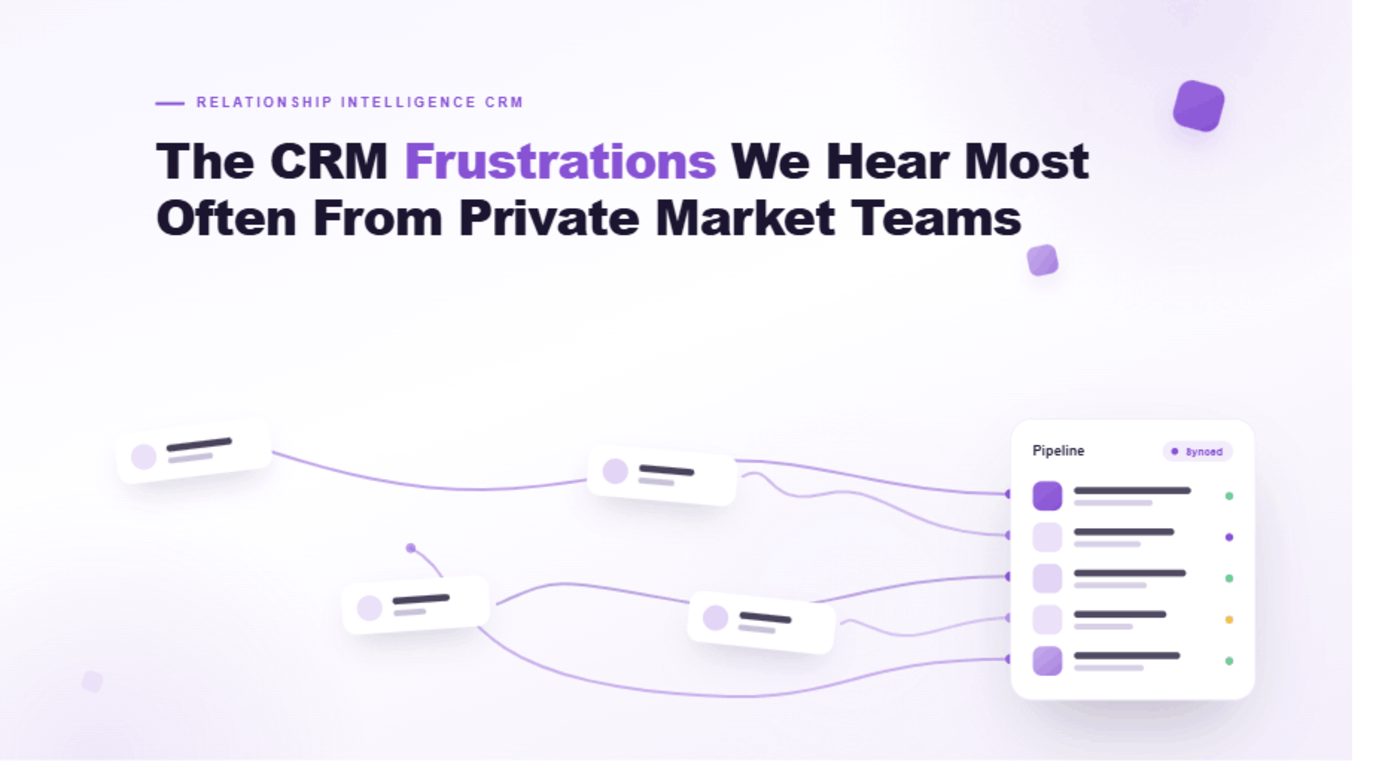
Across conversations with private market teams, the same CRM frustrations recur: too much manual work, poor adoption, generic workflows, limited relationship context, and reporting that still relies on spreadsheets.
The wrong CRM creates a hidden tax on the team. It adds administrative work, weakens adoption, fragments relationship context, and makes the firm’s data harder to trust.
The CRM Still Requires Too Much Manual Work
One of the most common frustrations we hear from private market teams is that the CRM does not actually reduce work.
It becomes another system the team has to feed.
That can happen with a broad range of tools, from generic platforms like HubSpot or Salesforce to private market systems, spreadsheets, and custom workflows.
The firm adopts a CRM to centralize activity, improve visibility, and create a more reliable source of truth. But in practice, they still have to manually log activity, tag contacts, update records, clean data, export reports, and prepare spreadsheets before internal meetings.
At that point, the CRM is not removing administrative work. It is adding a new layer to it.
This matters because deal teams are already working across inboxes, calendars, calls, meetings, research, introductions, and follow-ups. If every meaningful interaction has to be manually entered or later cleaned up, the system quickly becomes incomplete.
Too many clicks lead to skipped updates. Skipped updates lead to missing context. Missing context leads the team back to email threads, spreadsheets, and individual memory.
The same issue appears in reporting. If a team has to export CRM data into Excel, manipulate fields, clean up records, and rebuild the view before a pipeline or sourcing meeting, the CRM has not solved the workflow problem. It has simply moved the manual work to a different place.
For private market teams, the CRM should automatically capture more context. Email and calendar activity, contact enrichment, reminders, relationship history, and deal activity should help the system remain useful without relying on perfect manual upkeep from everyone on the team.
Generic Sales CRMs Do Not Match Deal Team Workflows
Many CRM platforms were built for sales pipelines, marketing automation, or high-volume outreach. Tools like HubSpot, Salesforce, Pipedrive, and other general-purpose CRMs can be valuable for teams managing leads, campaigns, and traditional sales processes.
But deal teams work differently.
A private market relationship is not the same as a sales lead. Private equity, venture capital, investment banking, M&A advisory, and corporate development teams manage networks of bankers, founders, LPs, advisors, intermediaries, lenders, co-investors, operating partners, and portfolio contacts.
Those relationships often connect to multiple companies, deals, funds, conversations, and future opportunities. A banker may be a deal source, a market reference, and a relationship several people at the firm know in different ways.
A generic CRM can store the contact, but it does not always show why the relationship matters.
Customization can help, but it often creates another layer of work. The more a firm has to reshape a system around private-market workflows, the more maintenance it may require.
For deal teams, CRM should do more than organize names and email addresses. It should reflect how the team builds relationships, tracks opportunities, and finds warm paths into companies.
Spreadsheets Work Until the Team Outgrows Them
Spreadsheets are often the first CRM for private market teams.
Excel, Google Sheets, shared folders, notes, and inboxes are flexible, familiar, and easy to start using. For a small team or early-stage process, that may be enough. One person can track companies, contacts, conversations, and next steps without needing a more formal system.
The problem shows up as the firm grows.
Once multiple people are sourcing deals, managing investor relationships, tracking banker coverage, or following up with executives, spreadsheets become harder to trust. The team may not know who last spoke with a contact, when the conversation happened, what was discussed, or whether someone else is already pursuing the same opportunity.
That creates coordination problems. Information gets trapped in individual inboxes, meeting notes, and memory. Reporting becomes manual. Follow-up becomes inconsistent. The firm may technically have the data somewhere, but it is not easy to find, connect, or act on.
This is why the move from spreadsheet to CRM is not just about better organization. It is about creating shared relationship memory across the firm.
For private market teams, the system should help everyone understand the relationship history, current activity, and next best action without relying on someone to search through a spreadsheet or remember the last conversation.
Adoption Breaks When the System Requires too Much Upkeep
A CRM can have a strong feature list and still fail if the team does not use it.
This is one of the clearest patterns we hear from private market teams evaluating broad enterprise systems, private market platforms, and lightweight CRMs. The issue is rarely just training. More often, it is workflow fit.
If a CRM feels like extra work, people avoid it. If updating records requires too many steps, the activity is not logged. If the system requires heavy implementation, ongoing customization, or constant admin support, smaller teams may struggle to realize the value.
Over time, the behavior shifts. A firm may still have a CRM in place, but the real source of truth moves back to individual inboxes, spreadsheets, notes, and memory. The platform remains active, but the relationship and deal context that matters most no longer lives there.
That is one of the hidden costs of CRM mismatch. The firm is not just paying for software. It is paying for a system the team does not fully trust or maintain.
For deal teams, the best CRM is not simply the one with the most features. It is the one the team can actually use in the flow of daily work.
Contact Storage is Not the Same as Relationship Intelligence
Deal teams are not just managing contacts. They are managing relationship context.
Knowing that a person exists in the CRM is useful, but it is not enough. The more important questions are: Who knows this person? How strong is the relationship? When was the last meaningful interaction? What was discussed? Is there a warm path into the company?
That context matters across sourcing, fundraising, diligence, business development, portfolio support, and exit planning. A banker may be relevant to a new platform opportunity. An LP may also be a co-investor. A founder may be a future target, referral source, or portfolio connection.
The value is not just in the contact record. It is in understanding how that relationship fits into the firm’s broader network.
Without that context, teams rely on memory and internal calls to figure out who knows whom. That slows down outreach, creates duplicated work, and makes it harder to act on the relationships the firm has already built.
It also limits AI readiness. As firms begin using AI for meeting prep, sourcing research, and relationship management, disconnected CRM data becomes a bigger problem. AI cannot surface warm paths, summarize relationship history, or recommend next steps if the underlying data is incomplete or scattered across inboxes and spreadsheets.
For private market teams, the real value of CRM is not only storing information. It is turning firmwide relationships into a strategic asset the whole team can use.
What Private Market Teams Should Look For Instead
The answer is not simply to buy a bigger, more customizable, or intricate CRM.
The better question is whether the system fits how the team actually works.
Private market teams should look for a CRM that reduces manual data entry, captures email and calendar activity, maps relationships, and makes warm introduction paths easier to identify. It should support deal-specific workflows instead of forcing the team into a generic sales process.
It should also reflect the different types of relationships a firm manages. LPs, founders, advisors, bankers, lenders, executives, co-investors, and portfolio contacts should not all feel like the same generic record.
Reporting matters too. If the team still needs to export data, clean spreadsheets, and rebuild views before every meeting, the CRM is not providing enough leverage. The data should be clean, trusted, and easy to use in day-to-day work.
That is especially important as firms begin using AI across sourcing, meeting preparation, and relationship management. AI is only useful when the underlying data is reliable and connected.
The right CRM should reduce administrative drag, improve relationship visibility, and give the team a shared source of truth.
The Wrong CRM Creates Hidden Costs
CRM frustration usually comes from mismatch.
A system built for mass sales, marketing automation, enterprise administration, or basic contact storage may work well in one environment but create friction for a relationship-driven deal team.
That friction becomes expensive over time. It shows up as manual data entry, spreadsheet workarounds, poor adoption, incomplete records, missed follow-up, and relationship context that never makes it into the system.
Private market teams need a CRM that supports how they actually work. That means helping the firm source opportunities, manage long-term relationships, coordinate outreach, prepare for meetings, track deal activity, and move work forward with less manual effort.
The goal is not simply to have more software. It is to build a shared system of relationship intelligence that the team can trust and use every day.
Want to see how 4Degrees helps private market teams manage relationships, deal flow, and firmwide context in one place?